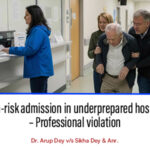

A critical care patient in a general ward fell off his bed and later died of intracranial bleeding. The family filed a complaint against the hospital, which the court dismissed, noting that the hospital fulfilled its duty of care through fall-prevention measures and documented emergency management.
Irrefutable Facts
A patient with advanced liver cancer was admitted to the hospital’s gastroenterology department. The hospital equipped his bed with protective side rails and a call bell. On admission, his family received formal orientation to fall-prevention protocols.
Early the next morning, while experiencing altered sensorium, the patient attempted to sit up unassisted and fell. A nearby family attendant could not prevent the split-second fall.
Hospital staff immediately attended to the patient, transferring him to the ICU, conducting brain scans, and arranging emergency neurological consultations. Despite intensive treatment, the patient succumbed to intracranial bleeding complicated by pre-existing clotting disorders.
The Dispute
The family alleged medical negligence, claiming that nurses ignored the bedside call bell, forcing the patient to sit up unaided. They also alleged that doctors failed to seek a timely neurological consultation and that fall-risk records were falsified.
The defence countered that side rails were installed and safety protocols were explained to the family at admission. Emergency head scans and expert consultations were conducted immediately after the fall. Furthermore, the patient’s severe liver disease led to abnormal blood parameters, increasing the risk of bleeding threefold.
Court’s View
The Consumer Court held that the hospital was not negligent. It noted that general ward nurses manage multiple patients simultaneously, making constant individual bedside monitoring infeasible.
The court emphasized that an unfortunate accident does not automatically constitute medical negligence. Given that the hospital maintained standard precautions, informed the family, and provided prompt emergency care, the court rejected the allegations of negligence.
Prevention is Better Than Cure
Formally assess patient fall risks at admission, instruct relatives on safety equipment, and obtain signed acknowledgements in the medical records.
Following any inpatient incident, promptly initiate multi-speciality evaluations and meticulously document all diagnostic and clinical steps.