

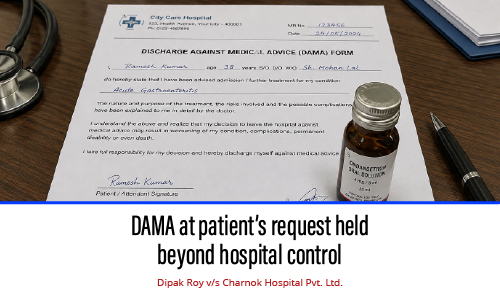
When a patient chooses to leave against medical advice, the course of care changes hands.
This case examines that delicate shift — where medical judgment meets patient insistence, and questions of responsibility begin to blur.
In situations like DAMA, what follows may not always trace back to the treatment given, but to the decision to step away from it.
Irrefutable Facts
The patient, suffering from palpitation, weakness and loss of appetite for the past 4 weeks, was admitted to the hospital. She was diagnosed as severely anaemic with suspected immune thrombocytopenia and hypothyroidism, managed conservatively and Discharged Against Medical Advice (DAMA) after a few days. On the following day of discharge, the patient died at her house.
Her family sued the hospital, alleging that the patient was not critical at the time of admission, but her condition deteriorated later due to a lack of proper care from the doctors of the hospital.
It was pointed out that the patient took DAMA due to a lack of care and a fear of increased hospital bills.
Hospital’s Plea
The hospital stated in defence that the patient was managed according to the accepted standards. However, on several occasions, the patient’s attendant was non-cooperative and did not consent to examining bone marrow or taking a haematological opinion.
It was pointed out that the doctor was dutybound to approve DAMA at the patient’s request, which could not be considered negligence.
Court’s Observations
The court, on perusal of medical records, was surprised to find that though the patient was anaemic and her condition was gradually deteriorating, her attendants refused to consult a haematologist as advised by the doctor, and instead took DAMA.
The court observed that the hospital was bound to discharge the patient at the request of her attendant and that no opportunity was given to the hospital to provide proper medical treatment.
The court further observed that there was a lack of cooperation from the patient’s side and that after taking DAMA from the hospital, the patient was not taken to any other doctor or hospital for further management; instead, she was kept lying in the house where she finally died.
Hence, the court dismissed the case against hospital.
Prevention Is Better Than Cure
Discharging a patient against medical advice (DAMA / LAMA) sometimes poses a big dilemma for the hospital / doctor, especially when the attendants of a critical patient seek DAMA and the medical team is convinced that such a discharge is not in the patient’s interest. However, there is no other option but to discharge such a patient. In all such cases, the doctor / hospital must take the request from DAMA in writing, preferably in the handwriting of the patient / attendants, and also document this fact in medical records, including the discharge card.
Source: Dipak Roy v/s Charnok Hospital Pvt. Ltd.