

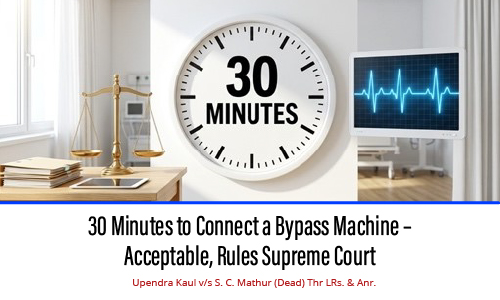
A medical crisis can escalate in seconds, leaving hospitals vulnerable to severe reputational damage. In a landmark decision, the Supreme Court exonerated a hospital and its doctor of negligence charges, ruling that a 30-minute response time to initiate bypass support during a cardiac arrest was acceptable. The judgment also underscores how meticulous medical record-keeping serves as a shield against legal claims.
Irrefutable Facts
During a high-stakes angioplasty, the patient suffered cardiac arrest and tragically passed away. The surgical team connected the bypass machine within 30 minutes and ensured the ventilator was in place.
A Consumer Court initially found the hospital negligent and ordered compensation, which was paid. The case was then appealed to the Supreme Court.
The Dispute
The patient’s family alleged that the hospital lacked ventilator support and delayed connecting the critical bypass machine, which caused the death. In response, the defence maintained that the ventilator was connected immediately and the bypass machine was initiated within the standard 30-minute window.
The lower Consumer Courts rejected the doctor’s explanation, citing administrative delays.
Courts View
The Supreme Court thoroughly analysed the actual procedure reports and expert opinions. It concluded that the ventilator was readily available and that the 30-minute timeframe to connect the bypass machine was entirely normal.
Overturning the lower Consumer Court’s rulings, the Supreme Court set aside all allegations of negligence. It specifically ruled that the compensation paid must not reflect on the professional competence of the medical team.
Prevention is Better Than Cure
Hospitals must keep vital emergency equipment, such as ventilators and bypass machines, fully functional and immediately accessible. Demonstrating that equipment was present and deployed promptly is crucial to disproving administrative negligence.
Accurate, timestamped reports, such as procedure logs, were the turning point in this case, proving the exact timeline of emergency care. Complete records are a healthcare provider’s strongest shield in court.
Source
Upendra Kaul v/s S. C. Mathur (Dead) Thr LRs. & Anr.